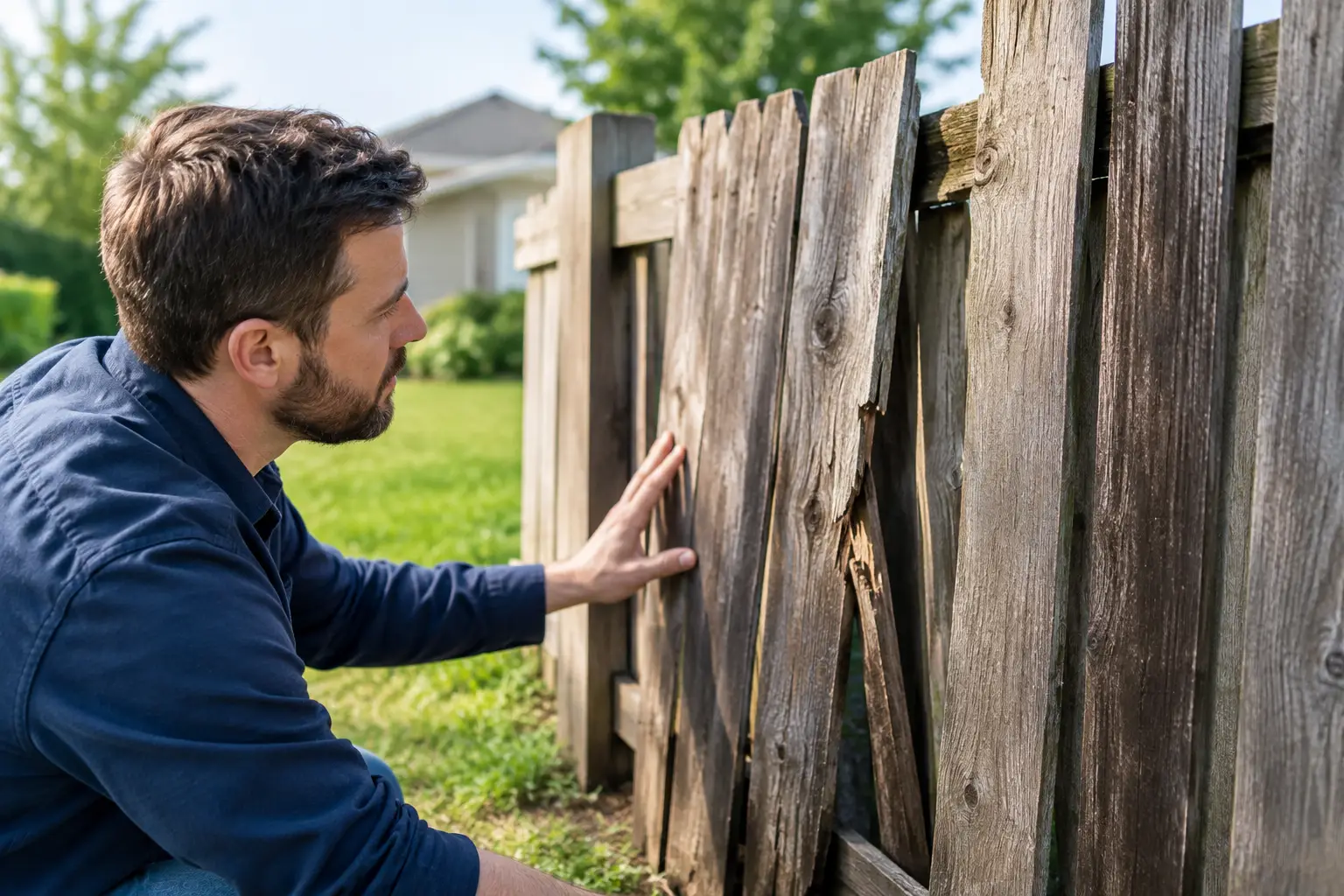
A fence rarely fails all at once. More often, a gate starts dragging across the ground, one section leans after a heavy rain, or a board comes loose where children or pets play. Knowing the signs you need fence replacement helps you address a worn-out fence before it becomes a safety issue, a security gap, or an ongoing repair expense.
For Lynchburg-area homeowners, weather, sloped yards, soil conditions, and normal daily use all affect how long a fence lasts. Some damage can be repaired effectively. Other problems point to a fence system that has reached the end of its useful life.
Signs You Need Fence Replacement Instead of Another Repair
1. Posts are leaning, loose, or rotting below ground
Fence posts carry the weight of the entire system. When posts begin leaning, the issue is often more serious than a panel that looks uneven. Wood posts can decay at or below the soil line, where moisture stays trapped and the damage is difficult to see. Concrete footings can also shift, crack, or lose their hold over time.
A single loose post may be repairable, especially after an isolated impact or storm. When several posts are tilting, soft at the base, or pulling a long section of fence out of line, replacement is usually the more dependable choice. Replacing only boards or rails will not correct a failing foundation.
2. Wood has widespread rot, splitting, or insect damage
A few cracked pickets are common on an aging wood fence and can often be replaced. The concern is widespread deterioration. If boards feel soft, crumble near the bottom, split along the grain, or show extensive insect damage, the fence may no longer provide reliable privacy or containment.
Look closely at rails and posts, not just the visible pickets. These structural pieces can weaken before the front of the fence looks severely worn. Repeated patching may make the fence look better temporarily, but it does not restore its strength.
3. Panels sag or sections pull apart
Sagging panels often mean the rails, fasteners, or posts are no longer doing their job. You may notice gaps opening between sections, boards dropping lower than neighboring boards, or rails separating from posts. On a wood privacy fence, this can quickly affect both appearance and security.
A small section may be repairable if the rest of the fence is stable. If sagging appears in multiple areas, it is generally a sign that the fence is aging as a system. Replacement gives you a straighter, stronger result than replacing one weakened piece after another.
4. Your gate no longer opens and closes correctly
A dragging or misaligned gate is more than an inconvenience. Gates place extra stress on posts and hardware because they move every day. When a gate will not latch, swings open on its own, or scrapes the ground, pets and children may be able to get out of the yard.
Sometimes new hinges, a latch adjustment, or a gate-post repair will solve the problem. But if the supporting posts are shifting or the gate opening has become out of square, a larger replacement project may be necessary. A properly installed replacement fence includes gate support designed for dependable daily use.
5. Rust or corrosion is affecting metal fencing
Chain-link and aluminum fencing are known for durability, but they are not maintenance-free forever. Surface rust on a small piece of chain-link hardware may be manageable. Rust that has spread across posts, rails, fittings, or the fabric itself can reduce strength and leave sharp edges.
For aluminum fencing, check for damaged coating, corrosion around connections, loose pickets, and bent sections. Aluminum is a strong choice for pool areas, property boundaries, and open views, but badly damaged sections may not match or connect securely with older materials. The condition of the full fence, not just one damaged area, should guide the decision.
6. Repairs are becoming frequent and expensive
One repair after a fallen branch or a storm is normal. Calling for repairs every season is different. If you are replacing boards, tightening hardware, resetting posts, and correcting gates on a regular basis, the cost and frustration can add up quickly.
This is one of the clearest signs you need fence replacement: repairs no longer solve the underlying problem. A new fence can be planned around your current needs, whether that means more privacy, a safer area for a dog, or a better-defined yard for a growing family.
7. The fence no longer provides privacy or security
A fence can be structurally intact and still no longer work for your property. Large gaps between boards, missing pickets, low sections, or damaged gates can make a yard feel exposed. If a pet can squeeze through an opening or a child can easily unlatch a gate, the fence is not meeting its basic purpose.
This is also a practical time to reconsider the fence type. A wood privacy fence may be the right fit for a backyard that needs screening. Vinyl can provide a clean, low-maintenance privacy option. Chain-link can be an effective solution for pet containment, while aluminum fencing offers an attractive boundary without blocking sightlines.
8. Storm damage affects more than one section
Central Virginia storms can bring strong winds, saturated ground, and falling limbs. After a storm, inspect the fence line for leaning posts, bent rails, lifted panels, broken boards, and damaged gates. Take care around downed fencing, especially if sharp metal, splintered wood, or unstable posts are involved.
If damage is limited to one section and the surrounding fence remains sound, repair may make sense. When a storm exposes existing rot, weak posts, or deterioration across several sections, replacement may be the more practical investment. A professional on-site assessment can distinguish between isolated damage and a fence that has become unreliable overall.
9. Your yard needs have changed
Replacement is not always caused by damage. A recently purchased home may have a fence that does not fit your household. You may have added a dog, installed a pool, started using the backyard more often, or decided that an open boundary no longer gives you enough privacy.
A new fence is an opportunity to match the material and layout to the way you use the property now. Height, gate placement, terrain, drainage, and access points all matter. A fence that looks good from the street but makes it difficult to move equipment into the backyard or safely contain a pet is not the right long-term solution.
10. The fence is visibly aging and hurting curb appeal
Fading, staining, warped boards, peeling finishes, mismatched repairs, and an uneven fence line can make an otherwise well-kept home look neglected. Appearance alone does not always require replacement, particularly when the fence remains structurally sound. Cleaning, staining, or replacing a few boards may be enough.
However, when cosmetic wear appears alongside loose posts, damaged rails, and recurring repairs, replacement can improve both the look and the function of the property. The goal is not simply a newer fence. It is a fence that suits the home, holds up to regular use, and creates a finished boundary around the yard.
When Repair Still Makes Sense
Fence replacement is not automatically the answer to every problem. A newer fence with one damaged panel, a broken latch, a few loose pickets, or a localized impact may be an excellent repair candidate. Repairs are often worthwhile when the posts are solid, the fence line is straight, and the surrounding materials are in good condition.
The decision comes down to the condition of the entire system. Replacing one failed component on an otherwise healthy fence is sensible. Replacing parts repeatedly on a fence with widespread structural weakness is usually a short-term fix.
Choosing a Replacement Fence for Your Lynchburg Home
Material choice should reflect the purpose of the fence as well as maintenance expectations. Wood privacy fencing offers a traditional look and strong screening, but it benefits from periodic care. Vinyl provides privacy with less routine maintenance and a consistent finished appearance. Chain-link is practical for enclosing a yard and containing pets. Aluminum fencing is a good fit when you want security and definition while preserving an open view.
Your lot also matters. Slopes, tree roots, drainage patterns, existing landscaping, and gate access can affect the right design and installation approach. A free on-site estimate gives homeowners a chance to discuss these details before committing to a material or layout.
Liberty Fence LLC helps Lynchburg homeowners evaluate aging residential fences and choose practical replacement options in wood, vinyl, chain-link, or aluminum. If your fence is leaning, repeatedly repaired, or no longer serving your household, an on-site conversation can turn an uncertain problem into a clear plan for a safer, more usable yard.